
Background
A public awareness initiative exploring approaches to preventing targeted violence and domestic extremism through community engagement and prevention. Although the initiative was ultimately not launched, it provided an opportunity to explore complex communication challenges at a national scale. The work presented here includes creative developed during the engagement, along with strategic thinking that reflects my own perspective on opportunities for long-term prevention. Throughout the project, one question continued to shape my thinking: How can communication move beyond awareness to become part of a long-term culture of prevention?
Communication Challenge
How do you communicate about domestic extremism and targeted violence in a way that encourages prevention without relying on fear, stigma, or stoking political polarization?
The broader initiative explored a preventative communication approach centered on community engagement, awareness, and support systems that could strengthen resilience and encourage early intervention. Building on that foundation, I explored an expanded communication framework that positions mental well-being and emotional resilience as lifelong skills—integrating age-appropriate education from early childhood through higher education as part of a long-term prevention strategy.
My Role
Creative direction and art direction
Proposed Program Name and Logo Options
“Common Safety” references basic precautions against everyday harms, like burns and falls. It suggests the everyday person in common situations in public, at work, and at home has an important role in protecting themselves and others with preparation and awareness. It captures the ubiquitous beginnings of targeted violence, as the U.S. grapples with its mass shooting epidemic, yet empowers us all to be more active bystanders to report concerns, and reach out to experts for support before tragedy strikes.
Creative Vision—Ending domestic terrorism becomes a practical matter of public safety. It normalizes discussion, learning and support for mental health where help becomes readily available, devoid of shame, and rounds out prevention. Mental health is human health—on par with first aid for ourselves', loved ones' and our community's physical health. Prevailing attitudes/data are showing greater understanding and acceptance of mental well-being as a critical component to overall health. Greater receptivity and everyday hands-on involvement spurs vigilance against a mass-shooting epidemic.
"Make it Stop" captures an unrestrained, emotional response to pain. Often characterized as a child's plea for help, it evokes a visceral and universal sentiment in the wake of increased mass shootings and driver rampage unleashed on open crowds. The mark represents prevention rooted in a down-to-earth "real & raw" approach in acknowledging the realities: the need for social connection, active listening, community education, mental health awareness and proactive bystanding.
Creative Vision—Embracing hard realities and difficult conversations, necessary in the face of political friction, means acknowledging we're all vulnerable, and need to work together for change. It places everyone in the same position of shared responsibility to avoid preventable, yet extreme harms. The phrase invites a culture shift from just empathizing to that of action toward meaningful change in policy, attitudes, behavior and practice to avoid the unthinkable. Action motivated by the heart is a powerful driver for action.
Logo Iterations

Exploration of negative space, hand drawn elements and type face customization
Concept Options—Poster Executions
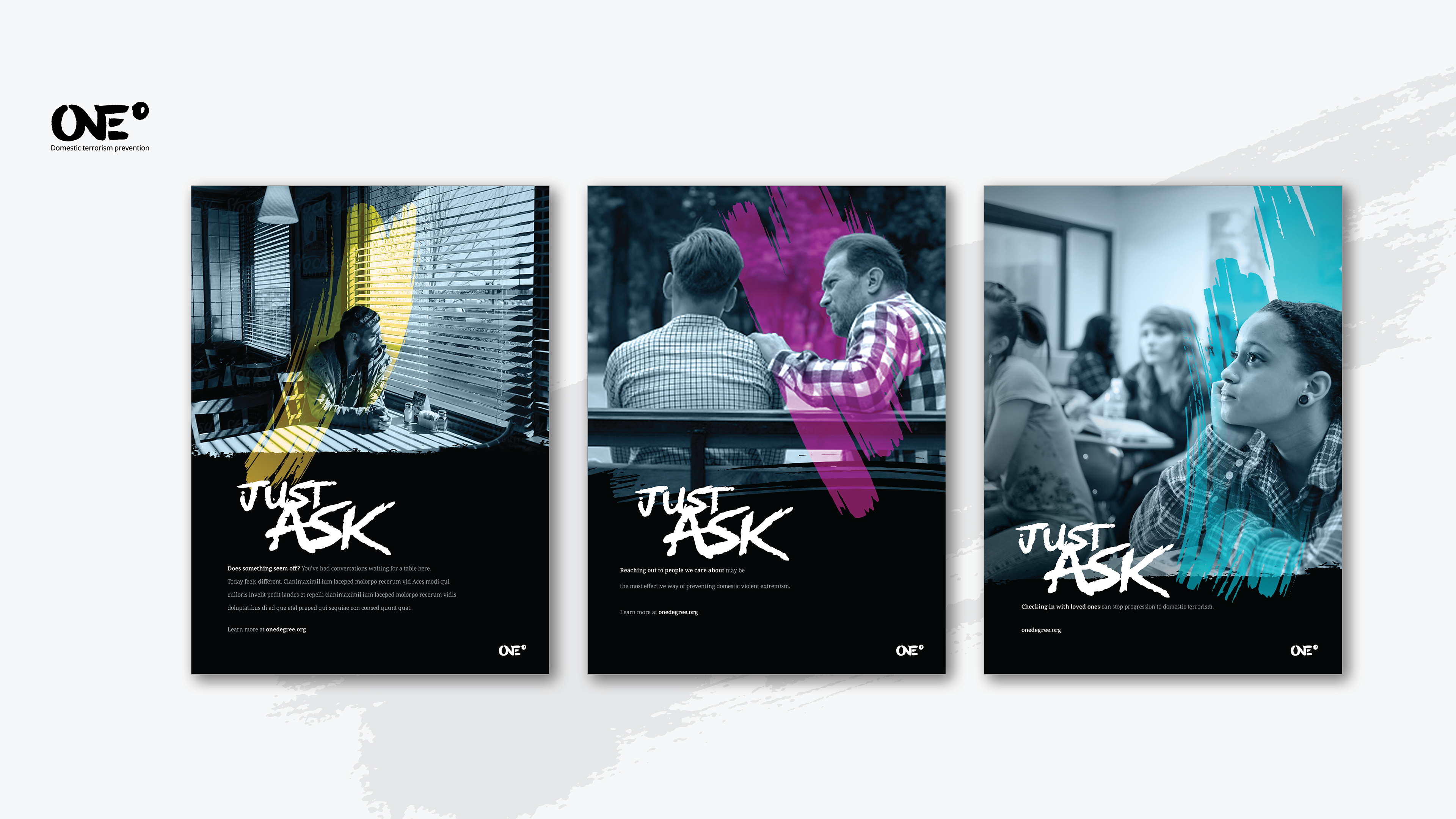
One Degree
"Our connection to each other is at the center of prevention"
"Our connection to each other is at the center of prevention"
Tone: human-centered | hand-made brush strokes | circle of influence
We come full circle after every mass shooting. The same signs were there, and it’ll likely happen again. But a shift of Oneº can change outcomes where human understanding and connection offer a critical space for prevention.
Power 2 Prevent
"We can all make a difference"
"We can all make a difference"
Tone: hidden in plain site | patterns | empowerment
We all have a key role in prevention. Learning and awareness is where it starts so we can understand the red flags. Data shows bystanders were often aware of potential for violence before it happened but dismissed their concerns. Learning to listen to ourselves and listen to others as an active bystander keeps us safe. We all have the power to prevent violent extremism before it escalates to violence.

Strategic Reflection
This project reinforced a principle that continues to guide my work: meaningful communication doesn't avoid difficult or inconvenient questions—it embraces them to better understand the human conditions influencing behavior. While the initiative focused on community engagement, awareness, and support, it led me to consider how communication might contribute much earlier by strengthening emotional resilience, mental well-being, and education as part of a broader culture of prevention. Thoughtful exploration from beginning to end uncovers innovative solutions that make a meaningful difference.
I've learned that the best creative work begins by asking better questions, challenging assumptions, and measuring success by outcomes rather than outputs. At the heart of that process is audience understanding—not simply knowing who people are, but viewing every creative challenge through the lens of the outcomes they tell us will help them most. That perspective gives communication its greatest purpose and responsibility: earning trust, fostering understanding, and creating thoughtful, human-centered solutions that make a lasting difference.
Creative Director/Art Director: Stephanie Bogue